 MB Medic Mercedes-Benz Repair Guides, Service, How To DIY

Last updated:
In this guide (7 sections)
This guide outlines the procedure for replacing the battery on a Mercedes-Benz. Replacing the car battery on a Mercedes-Benz is easy and can be completed by any DIYer. These step-by-step instructions on replacing Mercedes batteries should help owners of E, C, S, ML, CL, CLK, GL, GLK, and CLA models change the battery.
Aftermarket Mercedes-Benz Batteries
- Exide Edge FP-AGML4/94R Flat Plate AGM Sealed Automotive Battery
- ACDelco 94RAGM Professional AGM Automotive BCI Group 94R Battery
In this article:
- How to replace a Mercedes battery, DIY instructions
- How to Synchronize a Mercedes-Benz after Battery Replacement
- How to avoid losing the memory
- Mercedes-Benz Dealer Battery Cost
- Choosing the Best Battery for Mercedes
- Mercedes Replacementacemenet Warranty
Signs that the battery needs to be replaced include:
- Hard time starting the Mercedes in the morning
- Warnings related to the Charging System Malfunction
- Electrical Consumers switched off
- When you get this warning, the issue may be the secondary (auxiliary) battery, not the main Mercedes battery.
- Visit Workshop Warning
1. Mercedes Battery Replacement Procedure
While removing and installing a new battery on your Mercedes-Benz, you must be extremely cautious and avoid a short between the positive terminal and the body or the negative terminal.
Tools Needed
- 10mm socket
- 13mm socket
- 8″ extension
- Battery post-Cleaner
- Battery Terminal Protector
Parts Needed
- Replacement Mercedes Battery
(OEM or Aftermarket)
Mercedes Battery Removal Procedure
- Park your Mercedes-Benz. Engage the parking brakes. Remove the key from the ignition. This is important to avoid damage to electrical components.

 Locate the battery. Most Mercedes-Benz cars have the battery in the trunk on the right side. A few models, such as W203, R170, etc, have the battery in the engine bay and passenger side. At the same time, some models have the battery under the rear seat.
 Disconnect the negative battery terminal first. You must loosen the 10mm bolt and pull the terminal away from the post. If the terminal doesn’t come out easily, try twisting it and pulling it. Don’t use extreme force. If the battery cable clamp is stuck, use a battery terminal puller.
 Disconnect the positive battery terminal. Insulate the positive battery terminal with electrical tape. You want to ensure it doesn’t accidentally touch the car’s frame or any metal part.
 Remove the bracket that holds down the battery. This is a 13mm bolt. You must often use an extension to get to the bracket.
- Remove the old battery from your Mercedes-Benz. Use caution when removing the old battery, as car batteries tend to be heavy.
 Locate the battery. Most Mercedes-Benz cars have the battery in the trunk on the right side. A few models, such as W203, R170, etc, have the battery in the engine bay and passenger side. At the same time, some models have the battery under the rear seat.
 Disconnect the negative battery terminal first. You must loosen the 10mm bolt and pull the terminal away from the post. If the terminal doesn’t come out easily, try twisting it and pulling it. Don’t use extreme force. If the battery cable clamp is stuck, use a battery terminal puller.
 Disconnect the positive battery terminal. Insulate the positive battery terminal with electrical tape. You want to ensure it doesn’t accidentally touch the car’s frame or any metal part.
 Remove the bracket that holds down the battery. This is a 13mm bolt. You must often use an extension to get to the bracket.
Mercedes Battery Installation Procedure
The battery installation procedure is the opposite of removal.
- Lower the new battery in the battery tray.
- Install the battery bracket.
- Clean battery post using a battery terminal cleaner.

- Connect the positive battery terminal first.
- Connect the negative battery terminal last.

2. How to perform the Sync Procedure after Mercedes Battery Replacement
After you install the new battery in your Mercedes-Benz, you need to perform a few synchronization procedures. Follow the instructions below to sync your Mercedes and complete the battery installation procedure.
Synchronize windows
The one-touch or auto-close window functions will be lost. Press and hold the window switch until the window closes completely.
- Press and hold the window switch until the window closes completely.
- Once the window reaches the top, hold the button pressed for an additional three seconds.
- Lower the window and hold the button pressed for an additional three seconds after the window is fully lowered.
- Repeat this procedure for the other windows.
 Synchronize sunroof
When you try to open the sunroof, it will only move a couple of inches and then stop. To fix this, follow this procedure:
- Press the switch to close the sunroof all the way.
- Once the sunroof is closed, hold the switch for another three seconds.
- Move the sunroof to the back. Once the sunroof reaches the back, continue to hold the sunroof for another three seconds.
Calibrate the steering wheel
Once you complete the battery replacement on your Mercedes-Benz, start up your Mercedes-Benz. You will be greeted with warning messages, such as an ESP warning light, but don’t panic. To reset the ESP warning, follow this procedure:
- Start up your Mercedes-Benz
- Turn the steering wheel to the left and hold it there for two seconds
- Turn the steering wheel to the right and hold it there for two seconds
- Repeat the procedure one more time. Straighten the wheels
- Turn off the car and restart it. The ESP warning light should be off
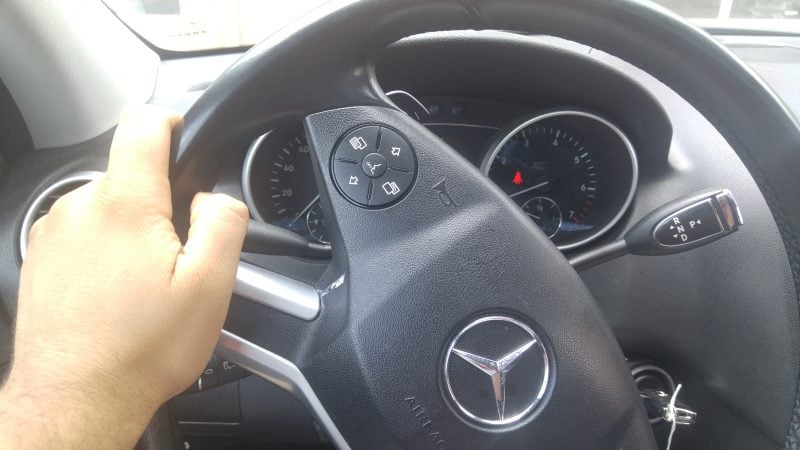 Set time
Follow the instructions to set the time. You will have to use the buttons on the steering wheel or the command buttons to set the clock on your Mercedes-Benz. Each model is different, so we can’t provide instructions on how to set the time here.
Radio Code
Several Mercedes-Benz models require that you enter a radio code after the battery replacement. You may be required to enter a radio code. This is often printed on the owner’s manual. If you can’t find the radio code, call your Mercedes-Benz dealer. They can look up the radio code if you provide the VIN.
3. How to change the Mercedes battery without losing the memory settings
You can avoid performing synchronization procedures by connecting a backup power source to your Mercedes-Benz before disconnecting the old battery. The backup battery or a jump starter must be connected at the jump-starting terminals under the hood, regardless of whether the main battery is under the rear seat, trunk, or engine bay.
- Locate the positive battery terminal used for jump-starting. It has a red cover. You will need to slide the cover to see the positive post. Next to the positive post, you also have a negative post.

- Connect your jumper starter or 12-volt backup battery source. Lithium jump starters such as NOCO Jump Starter works well for this task.


4. Mercedes Battery Replacement Cost
Mercedes battery replacement costs (US dealerships) varied between $280 and $400 in 2017. That includes the cost of a new car battery and its installation. Note that this is the price for the main battery, not the smaller secondary (auxiliary) battery.
For example, let us look at the price of replacing the main Mercedes battery in two vehicles, an S-Class and a C-Class. Below are the prices of how much it would cost to buy the battery at the dealer and how much it will cost to have the dealer replace the battery
- 2012 Mercedes-Benz S350 Blue Tech
- OEM Mercedes Battery Price: $247
- Installation Price: $140
- 2011 Mercedes-Benz C300 4-Matic
- OEM Mercedes Battery Price: $165
- Installation Price: $140
Cost to replace a Mercedes battery yourself
By replacing your Mercedes-Benz main battery, you can save between $100-$200. Replacing the battery is easy and takes less than $20 min. You can buy the battery from the dealer and install it, saving the installation cost, or buy an aftermarket battery that meets the OEM battery specs.
5. Choosing the Best Battery for Mercedes
If you search for an aftermarket battery that meets Mercedes specs, you will find a few good alternatives. When choosing a battery for your Mercedes, you must ensure it is the same group size. Generally speaking, most Mercedes-Benz cars use AGM H8 batteries. If you shop for a cheap Mercedes battery, search for Group 49 AGM Battery. Absorbed Glass Mat (AGM) batteries are recommended due to the high accessory load on Mercedes vehicles. It would help if you also found a battery with a similar Cranking Amp (CA) and Reserve Capacity (RC).
These values are printed on top of the old battery or can be verified by calling your Mercedes-Benz dealer.
Typical Mercedes battery:
- Group Size: H8 / Group Size 49 / 94
- Battery Type: AGM
- Cold Cranking Amps: 850
Mercedes Battery Size
Most Mercedes-Benz cars use a BCI Group 49 Battery. We wrote an in-depth article about choosing the best battery for Mercedes-Benz.
Two of our favorite batteries that are worth considering are:
6. Mercedes Replacement Warranty
As of July 2017, Mercedes-Benz OEM batteries have a two-year (24-month) warranty. Once the Mercedes battery warranty is over, it is the customer’s responsibility. There is no prorated coverage.
While a two-year battery warranty is better than some aftermarket batteries with a one-year warranty, it certainly isn’t the best battery warranty. Several aftermarket AGM-type batteries that fit Mercedes-Benz cars perfectly come with at least a three-year warranty. Mercedes-Benz should consider increasing the warranty period to improve customer satisfaction.
On most modern Mercedes there is a battery sensor clamped to the negative post, not just a cable. It is an intelligent sensor that measures state of charge, state of health and battery temperature, and it feeds the charging strategy and the stop and start system. On the dashboard it is invisible. In the trunk it looks like part of the cable.
So treat that terminal differently from an ordinary one. Do not lever the clamp off against the sensor body, do not let the battery take its weight when you lift the old one out, and when the new battery goes in, make sure the sensor goes back onto the new negative post properly rather than hanging on its wire. A sensor that has been strained or left half seated produces exactly the fault pattern people blame on the new battery: charge warnings, stop and start refusing to work, and a car that reports a battery problem on a battery three days old.
This is where the advice online splits, so here is the state of it rather than a false certainty.
If you fit a LIKE FOR LIKE replacement, the same capacity and the same chemistry as the battery that came out, most of these cars simply pick it up and carry on. Plenty of owners report exactly that.
If you fit a battery of DIFFERENT capacity, or you change from a flooded battery to an AGM, that is when registration earns its keep. The car holds a charging profile matched to the battery it thinks it has, and an uprated battery that is never registered gets charged to the old profile, so you paid for capacity the car will not use. Specialists are consistent on that point even where they disagree about whether a like for like swap needs anything.
So the practical rule is to decide this BEFORE you buy, not after. Match what came out and you most likely need nothing. Upgrade, and plan for the registration in the same visit.
- The vent hose. A trunk or under seat battery vents into the car rather than into the open air, which is why Mercedes routes a hose from the battery to the outside. If the old battery had one attached, the new one needs it attached too. And if the new battery has nowhere to attach it, stop and check you have bought the right battery for an inside the car installation rather than an engine bay one.
- The chemistry. Match AGM with AGM and flooded with flooded. These are not interchangeable for the charging strategy, and on a car specified for AGM the cheaper flooded battery is a false economy that tends to show up as a short life rather than an immediate fault.
Look back at the list of things you have to redo after the power goes: the windows, the sunroof, the steering wheel message, the clock, the radio code, and on many cars the seat and mirror memory. None of that is caused by the new battery. All of it is caused by the car losing power for the few minutes in between.
A memory saver plugged into the OBD2 port or a cigarette lighter socket holds the modules awake on a small external supply while the main battery is out, and the car never notices the gap. It costs a fraction of the time the sync work takes, and on a car with a radio code you cannot find it is the difference between a twenty minute job and an afternoon.
One caution: with a memory saver fitted the car is live the whole time, so the positive cable you just took off is still energised at the other end. Insulate it exactly as the removal steps describe, and keep tools away from it.
What a scan tool is worth on a battery job
Three things it does that nothing else here can.
It reads the actual battery voltage and the state of charge the car believes it has, which turns “I think the battery is weak” into a number before you spend anything. It shows whether other control units logged undervoltage faults while the battery was dying, which is how you find out that the warning lights across the dashboard were all one cause. And it clears the faults that the power interruption itself leaves stored, which otherwise sit there confusing the next person to scan the car.
The YOUCANIC UCAN-II Pro reads these Mercedes control units and runs the service routines rather than only pulling generic engine codes, covering nearly everything Xentry does apart from online VIN coding. On a car where the battery has been low for a while, that scan is the difference between replacing a battery and finding out what the low voltage already broke.
A deeply flat battery, a jump start gone wrong, or a reversed terminal can damage a control unit outright, and that is the expensive end of a cheap job. A dealer replacement has to be coded to the car, and on the ignition and key side the keys have to be matched again too.
Module Medics repair Mercedes control units at board level and return your own unit with its coding intact, which keeps the keys working and skips the programming appointment. Worth a call before accepting a replacement price, and worth knowing about before you connect anything backwards.
Related reading
Before you buy parts, scan every control module, not just the engine. It shows the root fault behind the warning lights and tells you whether the problem is still active. See how to do a full health check.


