 MB Medic Mercedes-Benz Repair Guides, Service, How To DIY

Mercedes-Benz owners may notice the check engine light plus P0170 and P0173 codes. Theoretically, these two codes mean the fuel mixture is too rich or too lean. Most of the time, these Mercedes-Benz fault codes are caused by a defective Mercedes Mass Air Flow Sensor (MAF) sensor. You can try cleaning the sensor, but that doesn’t always work. It is best to replace the sensor. If the codes remain, you may have a vacuum leak.
- P0170 Fuel Trim Malfunction, Bank 1
- P0173 Fuel Trim Malfunction, Bank 2
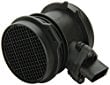 These codes can be misleading because if a mechanic goes by the book, he may not suspect the problem to be the MAF sensor. This issue can affect any Mercedes-Benz model, including C, E, S, ML, GL, CLK, GLK, SLK, and GLE classes. Other codes that you may get are P0130 and P0135. If you clear the P0170 and P0173 without fixing the underlying problem, those codes will return in a couple of days.
P0170 and P0173 are not mixture codes, even though everyone reads them that way. They mean the engine control unit has run out of room to correct. It has pushed its fuel adjustment to the limit and the numbers still do not add up.
The important part is what it was correcting FOR. In most of these cases the mixture itself is fine. What is wrong is the air measurement feeding the calculation: the mass air flow sensor reads low, the control unit believes less air is entering than really is, it trims the fuel to match, and the result is a perceived lean condition rather than a real one. A useful tell is that the oxygen sensors show nothing wrong with the actual mixture while the trims are pinned.
That is why chasing oxygen sensors, spark plugs and fuel pumps on these two codes so often ends in a bill and the same light. And it is why the air flow sensor is where to start even though it frequently sets no fault code of its own, which is exactly what makes it easy to overlook.
Cleaning a sensor and hoping is not a diagnosis, and it is the reason for most of the comebacks on this fault. There is a real test.
With a scope on the sensor signal, snap the throttle and read the peak on the second deep snap. A healthy Mercedes air mass sensor reaches roughly 4.0 to 4.2 volts. Anything in the region of 2.8 to 3.4 volts is a failed sensor.
Here is the part worth knowing: if the sensor fails that test BEFORE you clean it, replace it, even if it passes after cleaning. A cleaned sensor that was already out of specification comes back, usually within a few thousand miles, and you will have paid twice for the same diagnosis.
Symptoms
- Check the Engine Light On
- P0170 and P0173 Codes
- Car stuttering
- CEL may come on for a few days, then turn off
- Rough idle
- The car shakes, and runs roughly
- Hesitation during acceleration
Under certain circumstances, such as vacuum leaks, the car may run fine even if the CEL light is on and P0173/P0170 are present.
P0170 and P0173 Code Causes
- A defective mass airflow sensor is the most common cause of P0170 and P0173 on a Mercedes-Benz. The MAF sensor gets dirty over time, triggering the CEL and the two codes. If you use an air filter such as K&N, you may be contributing to this problem because these filters allow larger particles to pass and have oil that can coat the MAF sensor. Replacing the MAF sensor at the dealer can cost between $350 and $500. Replacing the MAF sensor yourself will cost you under $100. Replacing the MAF sensor is easy and can be found here.
- Vacuum leaks near the o-ring of the fuel injectors.
- There is a vacuum leak in the brake booster line.
- Cracked PCV hose or loose PCV valve.
- Fuel Supply Issue. It is more likely fuel-related if you have issues during a cold start.
Misdiagnosis
 If you troubleshoot this issue based on the two codes, a mechanic can misdiagnose the problem. These two codes are often misdiagnosed. Common misdiagnoses include bad Oxygen sensors or worn spark plugs. These items are unlikely to fix the P0170/P0173 codes. Always clean or replace the MAF sensor first.
How to Fix P0170 and P0173 on a Mercedes
- First, clean the Mass Air Flow (MAF) sensor. You will need MAF Sensor Cleaner to spray on the sensor. Mechanics or dealers are unlikely to perform the cleaning procedure, so you must try this yourself. Cleaning may not always work.
- Remove the mass air flow sensor.
- Spray MAF sensor cleaner on the plate inside. Avoid touching the sensor with an object. Only spray sensor cleaner.
- If cleaning does not fix the problem, replace the MAF sensor. The sensor is very easy to replace. Make sure to get a set of secure torx bits. A Secure Torx bit set can be purchased online and is inexpensive. Ideally, you should install anOEM Mercedes Bosch MAF Sensor because aftermarket sensors don’t work or last very long. If a bad MAF sensor caused P0170 and P0173, and you replaced the sensor, the CEL should turn off in a couple of days, even if you don’t clear the codes. If a vacuum leak causes the fault codes, the CEL stays on or returns.
- Check Fuel Filter
- Check Fuel Pump, Fuel Pressure, and Fuel Pump Relay
- Get an expert to look at your short-trim and long-trim fuel readings.
Replaced MAF sensor, but P0170 and P0173 are still on
 If the CEL stays on after you replace the MAF, there is a good chance of a vacuum leak somewhere. You will need to check for vacuum leaks. In one case, an ML-Class we worked on had a vacuum leak by the brake booster. The vacuum helps to add pressure to the brake system. The vacuum on one side of the brake booster diaphragm pulls the brake cylinder when you press the brakes. When there is a crack on the diaphragm or the O-rings of the brake booster, you will hear an air hissing sound near the brake pedal. Air is being pulled into the engine and not measured by the MAF sensor, triggering the P0170 and P0173 fault codes.
Of course, the vacuum leak doesn’t have to be at the brake booster; it can be in any of the vacuum lines attached to the intake manifold.
If it is not the MAF and not a leak either
If the sensor has been replaced and tested good and the intake has been smoke tested, these are the next candidates, and the order matters because it runs cheapest and most likely first.
- Carbon in the intake. On a direct injection engine the intake runners and the back of the valves foul up, and restricted airflow makes the measured air and the engine control unit’s expected values disagree. Decarbonizing the intake has fixed cases that looked exactly like a sensor fault.
- Camshaft timing. A cam phaser stuck off position, a timing chain stretched but not yet jumped, or a variable valve timing solenoid or oil pressure problem will mechanically lean the engine. The fuel trims compensate for a while and then run out of room, which is precisely what sets these codes. Timing deviation of roughly ten to twenty degrees is where the thresholds sit.
- Fuel pressure, but only with evidence. Test it when the fuel trims are erratic or when an oxygen or air fuel ratio sensor confirms the mixture really is lean. Replacing a fuel pump because of a trim code alone is one of the most common wasted repairs on this fault.
And a borescope down the intake is worth more than another parts order once everything above tests good.
What a scan tool actually needs to show you here
The reason this fault swallows money is that a code reader gives you the two codes and stops, and the two codes are the symptom rather than the cause. What splits the diagnosis is live data plotted against engine speed.
Plot fuel trim against rpm, then plot the air flow signal against rpm. In a healthy engine both change smoothly together. When the air reading and the calculated airflow the engine expects diverge, you have an air side fault and you can stop looking at the fuel system entirely. When the trims are erratic rather than steadily offset, or an oxygen sensor confirms a genuinely lean mixture, then the fuel side is worth testing.
That is also the test that tells you whether the problem is at idle or across the whole range, which is the fastest way to separate an unmetered air leak from a sensor reading low, because a leak is a large fraction of total airflow at idle and almost nothing at three thousand rpm.
The YOUCANIC UCAN-II Pro reads Mercedes live engine data including the air mass reading and the short and long term fuel trims, rather than only pulling the stored codes, which is the difference between knowing you have P0170 and knowing which side of the engine to work on. It covers nearly everything Xentry does apart from online VIN coding.
This is worth saying because it happens. When a shop runs out of ideas on a fuel trim code, the engine control unit sometimes gets replaced on guesswork, and it is the single most expensive wrong answer available on this fault. Nothing above points at the module.
If diagnosis genuinely does land on the control unit, which is rare on this code, a dealer unit has to be coded to the car. Module Medics repair Mercedes engine control units at board level and return your own unit with its coding intact. But get the air side data first, because on P0170 and P0173 the module is almost never the answer.


Hi I have a2011 merc c180 I recently bought.I drove a 200 kilos it showed the check engine light it lost power to accelerate but afteer I stoped for say 5 minutes I theen drove it for a thousand kilos wiith the engine light on.I paarked the vihicle for two hours after which wen I drove for 50kilos and. It displayed check cooolant and change oil in the next refuel i then stoped and the car water was overboiling.I towed the carr its stil starting but with a tattaattaa sound on the engine.
Hi on a C18o Cgi w204 2010 model i do get a shudder from the gearbox.after driving slow for 10 to 15 min.going up on incline not streep.when you push acc down a bit.the g/box judders.for 3 seconds or sow .Had all services done at MB dealers.the dash throws out brake wear .New pads front and rear.G/box not serviced yet or oil changed.car has done 142.000 km.From South Africa.
Hi on My c 180 CGI turbo a/t I do have a gearbox judder whèn I use the speedcontroll from 60 kmph to 80 kmph when driving die at least 10 min or so.shows brake wear but new pads fitted front and rear.Had all services done at MBenz dealer.Car has done 142.000 km.The shudder lasts for about 3 seconds maxt it happens only when gearing down .As gsr as i know the gBox oil hasnt been changed yet.