MB Medic Mercedes-Benz Repair Guides, Service, How To DIY

Last updated:
In this guide (7 sections)
AdBlue is just another name for Diesel Exhaust Fluid, or DEF. This solution of urea in water is injected into exhaust gases as part of the exhaust treatment system called selective catalytic reduction, or SCR.
Watch: Mercedes-Benz Engine Start Not Possible in X Miles: AdBlue Warning

This process converts up to 90% of the vehicle’s harmful nitrogen oxides into nitrogen and water. Modern diesel-powered cars combine this with other emission control systems to meet the highest emission standards while retaining high engine power outputs and fuel economy.
How does it work?
AdBlue is stored in an external tank with an internal delivery pump. From there, it is injected into the stream of exhaust gases through the injection valve. As AdBlue would freeze in low outside temperatures, the heater element is installed in the tank to prevent this.
An Electronic Diesel Control unit, or EDC, controls activation and AdBlue dosing. This regulation is based on several parameters:
- exhaust temperature,
- NOx content before and after the SCR catalytic converter
- The operational readiness of the AdBlue system itself.
Be aware that the AdBlue system in your Mercedes will start working only when all the parameters are fulfilled.
Common faults
 Although relatively simple, this system is very sensitive and delicate. Some of the common faults include:
- In-tank heater element, which burns out. The only solution is to replace it with a new one.
- The injector and connecting tubing clogged up. This system works only at high exhaust temperatures, so the urea solution can crystallize if you have frequent short journeys.
- The NOx sensor can break or give false readings
Countdown warning system
If the AdBlue system is malfunctioning, your Mercedes will be limited to the number of starts or miles driven before it can be restarted.
Dealing with any issues regarding the AdBlue system without delay is very important, because the countdown only runs one way. It counts engine starts rather than days, so a car sitting in the driveway keeps its remaining starts, and a car doing short errands burns through them fast.
One thing catches almost everyone out here. The countdown lives in the control unit and is tied to the stored fault, not to the fluid level, so topping the tank up does not reset it by itself once the car has logged a system fault. The fault has to be repaired and then cleared with diagnostics before the remaining starts go back to normal. That is why owners report filling the tank, driving away, and watching the number keep falling.
Depending on the model, you will get some of the following messages:
- AdBlue Check Additive See Operator’s Manual
- AdBlue Range
- Engine Start Not Permitted (AdBlue Empty)
- Check AdBlue. No engine Start is Possible in XXX miles/km.
- Check AdBlue Remaining starts X.
Resetting or hiding the countdown is not a repair, so the useful question is which of the two underlying problems you have. The two most common AdBlue faults are:
- DEF fluid level genuinely low, which a jug of fluid fixes for the price of a coffee.
- A fault inside the SCR system, where the tank may well be full and the countdown runs anyway.
Your Mercedes does not know how much AdBlue is in the tank. It knows what the level sensor reports, and it knows what the NOx sensors upstream and downstream of the catalyst measure. So the same Check AdBlue message covers two very different situations, and telling them apart before you spend anything saves most of the money on this job.
A level message on a tank you have not topped up for months is usually just a level message. Add fluid, drive a few miles, and it clears on its own.
The same message on a tank you filled last week is a system message wearing the same clothes. Topping up again changes nothing, because the car is not complaining about fluid. It is complaining that the readings do not add up. The two usual culprits there are the AdBlue level sensor, which crystallizes and then reports empty on a full tank, and a NOx sensor that has drifted or died. On several models the level sensor is only sold as part of a complete tank, which is why a quote for what sounds like a sensor comes back shockingly high.
Can you ignore a Mercedes AdBlue warning?
An AdBlue fault does not damage the engine itself. Fuel, air and combustion carry on exactly as before, which is why owners assume the warning is cosmetic.
It is not cosmetic, for three reasons. The countdown is real, and once remaining starts reach zero the car will not restart, wherever it happens to be parked. Defeating the system with an emulator or a software delete is a federal emissions violation in the United States, fails inspection in states that test, and is one of the first things a buyer or a dealer checks. And a car driven for months with an inoperative SCR system is usually also crystallizing urea around the injector and lines, which turns a sensor job into a tank and injector job.
One point of model history worth correcting, because it causes a lot of confusion: AdBlue is not defined by the year. The 2007 to 2009 E320 BlueTEC used a DeNOx storage catalyst and has no AdBlue tank at all. The ML320, GL320 and R320 BlueTEC from 2009 onward, and the Sprinter, do use urea injection. So “my older diesel never had this” is a model distinction, not a year one.
Troubleshooting
First, check the AdBlue level and top it up if needed. You can buy AdBlue fluid from any Mercedes dealer or a generic Diesel Exhaust Fluid from auto part stores or gas stations.
If there is a fault within the system, the following should be checked:
- Values from temperature sensor upstream of the SCR catalytic converter
- Values from the NOx sensor control unit upstream of the SCR catalytic converter
- Values from the NOx sensor control unit downstream of the SCR catalytic converter
- AdBlue tank for DEF quality and quantity
- AdBlue delivery pump and injection valve
- AdBlue metering amount
- Visually check for leaks, and for white crystal deposits around the injector, the pump and every line fitting
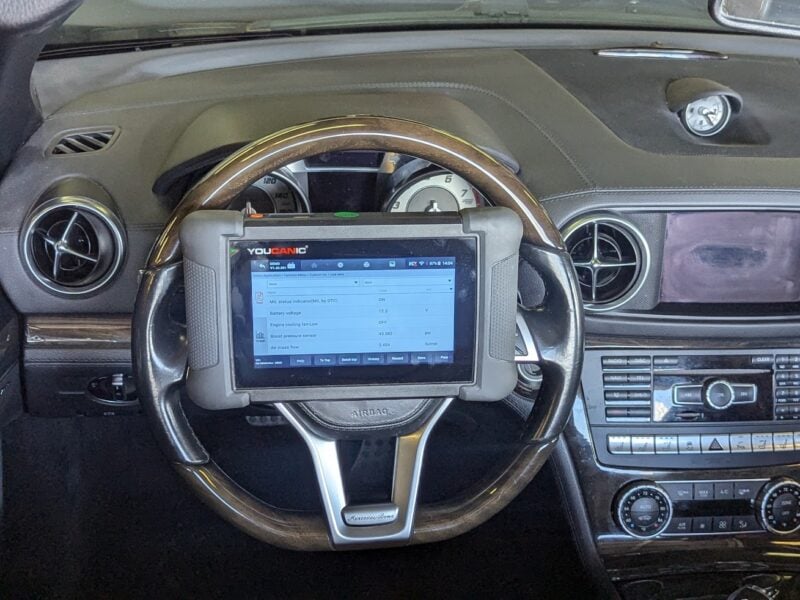
Nothing on the dashboard tells you which of those items failed, because they all produce the same Check AdBlue text. A scan tool that talks to the Mercedes SCR and engine control units shows you the stored SCR fault codes, the AdBlue level the car believes it has, the countdown value it is holding, and live NOx readings upstream and downstream of the catalyst. Two NOx figures that track each other mean the catalyst is not converting. A level reading that disagrees with a tank you just filled points at the level sensor rather than the fluid.
The YOUCANIC UCAN-II Pro reads and clears SCR and emissions faults on these cars and shows that live data, which a generic code reader will not. It covers nearly everything Xentry does apart from online VIN coding, so it is a realistic way to see the AdBlue system from your own driveway instead of paying for diagnostic time to be told which sensor it is.
How do I refill AdBlue?
 This is as easy as filling up with fuel. DEF tank filler is located next to the fuel fill cap. Just open the fuel lid and locate the blue colored cap. Remove the cap, and fill up the tank with Diesel Exhaust Fluid.
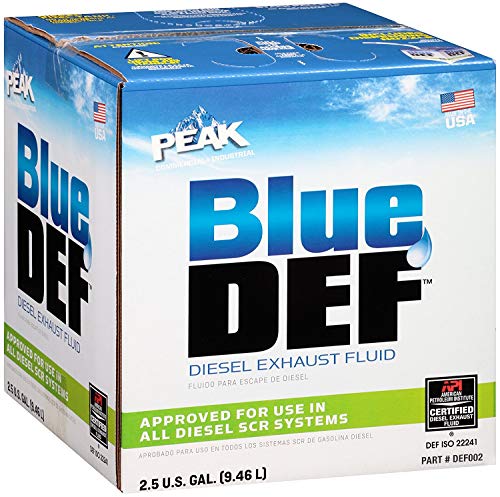
Make sure to add AdBlue to the correct tank. Do not mix AdBlue with diesel fluid. AdBlue is not an additive or a lubricant. Do not mix water with AdBlue.
Occasionally the stored codes point at the module rather than the parts it reads: an SCR or engine control unit with internal communication faults, water ingress, or damage after a jump start or a deeply flat battery. A replacement unit from a dealer has to be coded to the car, which is why that quote lands in four figures. Module Medics repair Mercedes ECU, SAM and related control units at board level and return your own unit, so the car keeps its existing coding and no programming appointment is needed. This only applies when diagnosis actually points at the module, so get the codes read first.
Related reading
Before you buy parts, scan every control module, not just the engine. It shows the root fault behind the warning lights and tells you whether the problem is still active. See how to do a full health check.