 MB Medic Mercedes-Benz Repair Guides, Service, How To DIY

Last updated:
In this guide (12 sections)
- Fill up the fuel tank
- Perform Routine Maintenance
- Check Tire Pressure
- Use Vehicle Cover
- Leave the parking brake off
- Disconnect the battery, or fit a tender
- Fluids
- Do not start it every few weeks
- What to check when it comes back out
- Does any of this need a diagnostic scanner?
- If a module did get damp over the winter
- Related reading
For some Mercedes-Benz owners (especially the lucky ones with a convertible), the winter ends the summer fun. Storing your Mercedes-Benz the right way is important to ensure you will not be greeted with warning lights when you need to start your car again. Or worse, not greeted at all. Here is a list of things you may want to consider as you winterize your Mercedes-Benz.
Here are a few valuable tips for Mercedes-Benz drivers. If you don’t drive your car in the winter and want to store it, follow these easy tips.
Fill up the fuel tank
 Don’t leave the car parked with a nearly empty fuel tank for months. The space in the fuel tank of your Mercedes-Benz will contain vapor, and over time, it will condense into water. The water will not only contaminate the gasoline, but it can also cause corrosion, especially to the fuel level sensor. Otherwise, you may have problems such as the fuel gauge no longer working or showing the correct gas level.
Filling the tank is only half of it. Pump gasoline has a shelf life of roughly 30 to 45 days before it starts to go stale, which is shorter than almost any storage period, so add a fuel stabilizer to the full tank and then drive far enough to pull the treated fuel through the lines and into the rail. A full tank of stale, untreated fuel is its own problem in spring.
Perform Routine Maintenance
 If your Mercedes-Benz is nearing routine maintenance such as Service A, B, C, D, and E in the next 500 miles or 30 days, you may want to perform the maintenance before storing your MB.
Check Tire Pressure
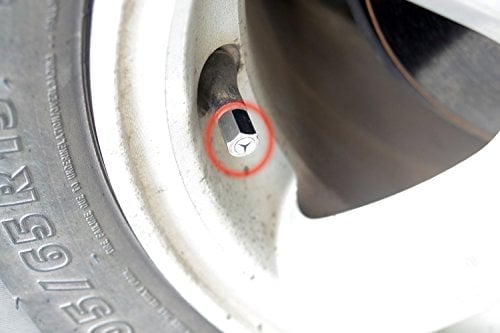 Add air and raise the pressure well above the normal setting, which is what limits flat spotting over a long sit. One limit to respect: do not go past the maximum pressure molded into the tire sidewall, which is a property of the tire and is not the same number as the placard pressure on your door jamb. Note the pressure you set, and remember to put it back to the door jamb figure before the car goes back on the road in spring. The tires will likely lose some air even if you have no leaks. This will minimize the flat spotting of the tires. If you don’t have a tire inflator at home, you can use an air compressor that plugs into the cigarette lighter and inflates your tires. We like the EP Auto 12V 120W Tire inflator because it comes with a digital gauge and will turn off once the tire pressure reaches the previously set PSI.
Use Vehicle Cover

If you are planning on storing your Mercedes-Benz, it is recommended that you use a cover. This will prevent damage to the car’s paint. Replacement covers can be purchased at any local store or online. You don’t need to get a cover designed specifically for Mercedes-Benz; any universal cover will be better than nothing, as long as it fits on the car. Most MB cars need a large car cover for S, CLK, CLS, and CLA-Class. Small or mid-size vehicle covers may be hard to fit even on a C-Class, but may work on S and SL classes.
Car covers such as OverDrive PolyPro Full Size Car Cover by Classic Accessories have great reviews on Amazon and are large enough to fit most Mercedes-Benz sedans.
Leave the parking brake off
Disconnect the battery, or fit a tender
 We prefer to disconnect the battery if you plan on letting the car sit for several months. Remember that when you start the car again, you must synchronize things such as the windows by pressing and holding the window switch for 5 seconds once the window hits the top. Sync the sunroof by moving it all the way to the back, then hold the switch for another five seconds. Repeat the same procedure but move the sunroof to the front and hold the switch after the sunroof closes.
You will also need to reset the steering angle sensor; otherwise, the dashboard will have ABS and ESP defective warnings. To reset the steering angle sensor, start the car and turn the steering wheel to the right and then to the left. Do this a couple of times and then restart the car. The warning lights should disappear.

If you don’t feel comfortable with disconnecting the battery, your other option would be to connect a battery tender such as Black and Decker 12 Volt charger to ensure that the battery will always remain charged.
Fluids
 Make sure that your systems have the correct fluids. What do we mean? Your coolant should have a 50/50 mix, not just water. You shouldn’t have water in your cooling system anyway. If you live in very cold climates, you may want to change the mixing ratio to 30 water and 70 antifreeze.
Ensure you also have windshield washer fluid that will not freeze in low temperatures. It is not uncommon for owners to fill up the windshield washer fluid reservoir with just water. If you are going to store your Mercedes-Benz for the winter, you should make sure to use something such as Rain-X Winter Windshield Washer Fluid -25 Degree. Add the correct windshield washer fluid reservoir if you have only water in your windshield washer fluid. Then run the wipers for a few minutes to get the windshield washer fluid into the lines. Otherwise, the lines can freeze during the winter, especially if you have been using just water. This can cause cracks and windshield washer fluid leaks.
Do not start it every few weeks
This is the most common storage habit and it works against you. Starting a stored car and letting it idle, or taking it once round the block, never brings the engine, oil and exhaust up to the temperature needed to drive off the water and fuel that combustion puts into the oil. The short run adds contaminants and then shuts down before boiling any of them off, so the oil ends up in worse condition than if the car had simply been left alone, and the starts take more out of the battery than the brief run puts back.
- Stored. Battery disconnected or on a float tender, fuel stabilized, parking brake off, wheels chocked, and the engine not started at all until you are ready to use the car properly again.
- In light use. Battery connected, and every few weeks you actually drive it far enough and long enough to reach full operating temperature, which generally means a real drive rather than a trip to the end of the road.
What does not work is the middle ground, which is starting it occasionally and never driving it. That is the one choice with all of the downsides and none of the benefits.
We hope you will find these tips on storing a Mercedes-Benz for the winter useful. Use the comments section if you have any advice or recommendations that you would like to share with fellow MB owners.
What to check when it comes back out
Spring is where storage mistakes show up, and two of them are things you did on purpose in the autumn.
- Put the tire pressures back. You raised them deliberately to stop flat spotting. They are now wrong for driving. Reset them to the door jamb figure, and check them again after the first drive, since tires lose air while parked.
- Expect warning lights if the battery was off. The windows, sunroof and steering angle sensor all need the resynchronizing described above. Lights on the first start after a battery disconnect are usually this and not a fault.
- Look underneath before you move it. A puddle that appeared over the winter tells you more than anything a scan tool will.
Does any of this need a diagnostic scanner?
No. Everything on this page is a tank of fuel, a tire gauge, a cover, a battery tender and a decision about how you are going to leave the car. None of it calls for a scan tool, and it would be dishonest to pretend otherwise on a storage checklist.
Where one earns its place is the first start in spring, and specifically in telling apart two things that look identical on the dashboard. After months parked and a battery disconnect, a cluster full of ABS, ESP and similar warnings is usually just the steering angle sensor and the other adaptations waiting to be relearned. But a battery that sat and sulfated, or a module that got damp in an unheated garage, produces warnings that look exactly the same and will not drive away.
The YOUCANIC UCAN-II Pro reads the body and chassis modules, not only the engine, so you can see whether those lights are stored adaptation faults that clear once you relearn them, or live faults that are still present. That is a five minute answer instead of a fortnight of wondering.
If a module did get damp over the winter
This is the one storage outcome that turns expensive, and it is worth knowing the options before a quote lands. Damp in an unheated garage, or water finding its way in while the car sat, is a common way for control modules to fail quietly over a winter.
A replacement module has to be coded to the car. A board level repair of the original does not, so the coding and the adaptations stay as they are. Module Medics repair these units at board level and return the original. The honest caveat applies with particular force after storage: find where the water came in and deal with it first, because a repaired module put back into the same damp garage has the same winter ahead of it.
Related reading
Before you buy parts, scan every control module, not just the engine. It shows the root fault behind the warning lights and tells you whether the problem is still active. See how to do a full health check.


Thank you for writing the information I was looking for. I couldn’t get a straight answer from the dealer, on how to winterize my SL 550. I’m looking for information on how to lift my MB off the floor for the winter,ie where to position the support jacks. The reason why I thought of doing this is, I won’t need to play around with tire pressure and most important, I would like to start it and shift it in drive to have parts moving during winter,( I don’t want to drive it around in snow and salt). My SL has two(2) batteries and would like to connect a battery tender to both, any ideas on how this can be done, do I need to purchase two battery meanders?
Thanking you in advance for any advise you may want to share.
Cam
Locate both batteries. Disconnect the negative terminal from both. Connect one battery tender to each battery.