 MB Medic Mercedes-Benz Repair Guides, Service, How To DIY

Last updated:
In this guide (5 sections)
The 722.9 automatic transmission by Mercedes-Benz is an electronically controlled gearbox with seven forward gears and two reverse gears. This article overviews the 722.9 automatic transmissions, common problems, troubleshooting tips, and frequently asked questions.
Advantages of Mercedes 7G Automatic Transmission
There are several advantages to having 7 gears. Here is a list of benefits of the Mercedes-Benz 7-Speed transmission over the previous generation’s 5-Speed transmission (722.6).
- Smoother shifting and driver comfort
- Quicker upshifts/downshifts
- Better acceleration times due to improved control of gear changes and available gear ratios.
- Improved fuel economy.
- Better matching of engine RPM and vehicle speed.
The 7G Tronic transmission’s transmission control unit monitors your driving style and adapts the transmission shift points accordingly. For example, if you are an aggressive driver, you may notice that the transmission stays in gear longer to allow the engine to reach higher RPMs.
The 7-Speed Mercedes-Benz automatic transmission is known as:
- 722.9xx Automatic Transmission
- NAG 2 (New Automatic Gearbox 2)
- 7G-Tronic (7G Tronic Plus since 2010)
One of the main differences between the 722.6 5-Speed and 722.9 7-Speed transmissions is that in the 7G Tronic, the Transmission Control Module (TCU) is integrated inside the transmission. The TCU is mounted on top of the valve body, while in the previous automatic transmission, the TCU was installed outside the transmission. By installing the TCU on top of the valve body, Mercedes could reduce the length of the wires between the valve body and the TCU.

As with the 5-speed transmission, the 7G Tronic has the S / C mode, meaning:
- S – Sport – Car Starts in 1St Gear
- C- Comfort – Starts in Second Gear
7G Tronic Transmission Problems – 722.9xxx
Below is a list of common problems with the Mercedes-Benz 722.9xx 7G Tronic 7-Speed Automatic Transmission.
This list is for reference only. Suppose you are experiencing problems with your Mercedes-Benz. In that case, reading the fault codes from the automatic transmission unit via the OBD-II port located under the dashboard is important. You will need a scanner that can read TCU fault codes on a Mercedes to do that. A good scanner to use is the YOUCANIC full system scanner.

The 722.9 transmissions were installed in Mercedes-Benz models as early as 2004. By 2008, it replaced the 722.6 5-Speed transmissions on all MB models. This transmission has a few common issues, but most problems do not require a complete transmission overhaul. Replacing the defective solenoid, conductor plate, or valve body must be performed to fix most problems in the 7-Speed transmission.
This is a list of common problems with the 7-speed 722.9xx transmission:
- The transmission does not shift gears or work properly until it warms up.
- Delayed or unexpected shifting of gears. Upgrading the TCU software and resetting the transmission shift points may solve this problem. You will need either the dealer or an auto repair shop that has Mercedes Star Diagnostic C3 or C4 scanner.
- The transmission slips between 1st and 2nd gear. As soon as the TCU detects this, it goes into limp mode. Turning the engine in and off may temporarily return the transmission to normal operation.
- The conductor plate is defective. Replacement is required, which can cost between $2000-$3000. The first generation of the 722.9 may also require the replacement of the valve body.
- Accelerating from a stoplight can cause the car to get stuck in 2nd gear, limp mode.
- Standing water in contact with the housing can cause damage to the transmission housing if left in contact for several weeks.
- Hard shifting transmission problems.
Defective valve body or the conductor plate are usually the cause for these problems.
7G Tronic Fault Codes
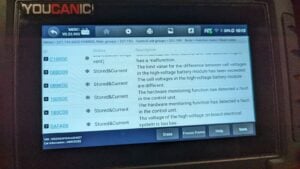
The most common fault codes of the 7-speed automatic Transmission are listed below.
- P0717 Input Turbine Speed Sensor Circuit No Signal
- P0718 Input / Turbine Speed Sensor Circuit Intermittent
- P0700 Transmission Control System TCS Malfunction
- P0748 Pressure Control Solenoid ‘A’ Electrical
- P0778 Pressure Control Solenoid ‘B’ Electrical
- P0798 Pressure Control Solenoid ‘C’ Electrical
- P2716 Pressure Control Solenoid “D” Electrical
- P2725 Pressure Control Solenoid (E)
- P2734 Pressure Control Solenoid ‘F’ Electrical
- P2759 Torque Converter Clutch Circuit Performance
P2810 Clutch Pressure Control Solenoid Performance - U0101 – no communication with the TCM
This problem is usually fixed by replacing the conductor plate or the valve body, depending on the VGS version. If a new TCU is installed, it will require programming to match the vehicle’s VIN.
Related Failure Codes
Error Code 0717 – The signal from component Y3 / 8n1 (turbine speed sensor (VGS)) is unavailable.
Error code 0718 – The component Y3 / 8n1 (turbine speed sensor (VGS)) is defective.
Error code 2767 – The signal from component Y3 / 8n2 (Internal speed sensor (VGS)) is unavailable.
Error code 2768 – The component Y3 / 8n2 (Internal speed sensor (VGS)) is defective.
How to Diagnose 7G Tronic Problems
Check Transmission Oil Level
The 722.9 7G transmission has no oil dipstick. It doesn’t have a dipstick tube either; therefore, you will not be able to use the Mercedes 722.6 Transmission Fluid Dipstick Tool.
Checking the fluid requires raising the car and removing the drain plug from the transmission. You need a special tool to fill the Mercedes-Benz 722.9 transmission. The car needs to be level during this procedure, and the transmission fluid needs to be at a particular temperature.
 The new 7G Tronic Plus transmission has new requirements for the automatic transmission fluid. You need to make sure that if you change the transmission fluid, you use the approved mercedes 722.9xx transmission fluid
Limp Mode
Whenever there is a problem with your transmission or certain sensors that send data to the TCU, the 7G Matic transmission goes into limp mode. During the LIMP HOME MODE operation, the transmission gets stuck in second gear and refuses to change gears. In second gear, you can only drive up to 30 MPH, so you should take your car to your mechanic as soon as possible.
If your MB is stuck in second gear (limp mode), don’t panic. It can be something as simple as low transmission fluid. It could even be something not directly related to the transmission, such as a defective ABS sensor, brake light switch, or even a steering angle sensor. The automatic transmission in your Mercedes-Benz is electronically controlled and depends on input from several sensors to work properly. Often, all you need to do is read the trouble codes with adiagnostic scanner to find the cause of your transmission getting stuck in gear.
Read Fault Codes
 If the check engine light is on, use a diagnostic scanner to retrieve the fault codes. Any generic OBD-II scanner can read the basic codes from a Mercedes built after 1996, though the codes that actually name a failed transmission part are not in that generic set. You can plug the scanner into the OBD-II port under the dash on the driver’s side. Look right above the brake pedal. Once you connect the scanner, press the READ button, and after a minute or two, you should have a trouble code such as P0715 or P0700.
For those who would like to perform in-depth transmission troubleshooting, you will need an advanced diagnostic scanner: an OBD-II / CAN Scanner that can read Transmission Control Unit (TCU) fault codes. The scanners mentioned above can only read codes from the Engine Control Unit (ECU), which will have generic codes such as P0700, P0715, etc.
Very few scanners sold online will allow you to read codes from the TCU on a Mercedes-Benz. The YOUCANIC SCANNER is a professional scanner that can retrieve fault codes from the TCU and almost any system on your MB. Not only that, but it can perform programming and testing of sensors similar to Mercedes Star Diagnostic C3 or C4.
Conductor Plate or Valve Body? The Codes Decide
Nearly every expensive mistake on this transmission comes from getting this one question wrong. The conductor plate is the electronic part, and the speed sensors are built into it rather than bolted on separately. The valve body is the hydraulic part underneath. They fail differently and the stored codes tell them apart in about two minutes.
| Conductor plate | Valve body | |
|---|---|---|
| Codes stored | Speed sensor codes: 0717, 0718, 2766, 2767, 2768 | No speed sensor codes. Solenoid and torque converter codes instead. |
| How it behaves | Holds a gear too long then slams into the next one, delayed engagement into Drive or Reverse, drops into limp mode. Often intermittent at first and worse once warm. | Harsh or soft shifts, starting off in the wrong gear, torque converter lock up complaints. |
| Why | The plate cannot read input shaft speed, so it cannot judge converter slip and lock up stops working. | Wear in the pressure regulator bores lets line pressure drift high or low. |
- Read the transmission codes first, from the transmission module and not just the engine.
- Speed sensor codes present? The conductor plate is your answer. Those sensors are inside the plate and cannot be replaced on their own.
- Codes clean but the shifts are wrong? Now look at the valve body.
- Drop the pan and look at it before you commit either way. Metal fragments mean the torque converter lock up clutches have failed, and no valve body or plate repair will fix that.
Which VGS Do You Have, and Why It Changes the Bill
The article you are reading is not the only place that mentions VGS versions without saying how to tell them apart, so here is the practical version. The conductor plate carries an engraved version number, and which generation you have decides whether the valve body has to come out with it.
| Version | Roughly | What has to be replaced |
|---|---|---|
| VGS1 | 2004 to 2007 builds | Conductor plate and valve body together, as a pair. This is the expensive one. |
| VGS2 | Later builds | Conductor plate on its own. The original valve body stays in the car. |
| VGS3 | Later builds | Conductor plate on its own, same as VGS2. |
Red Fluid or Blue Fluid?
This catches people out and the wrong fluid causes shifting complaints that look exactly like a failing valve body. The 722.9 changed specification partway through 2010.
| Build date | Fluid | Spec |
|---|---|---|
| Before 21 June 2010 | Red | MB 236.14 |
| From 21 June 2010 onward | Blue | MB 236.15 |
Conductor Plate / Valve Body
 Changing the conductor plate or the valve body may sometimes be necessary. Depending on the VGS version (1, 2, or 3), you may need to replace both the valve body and the conductor plate. If you have VGS1, you must simultaneously replace the conductor plate and valve body. If you have VGS 2 or 3, you can replace the conductor plate and keep the original valve body. If the existing unit can not be repaired, the new TCU will require SCN & CVN coding and can only be performed by the dealer or an authorized repair shop.
Frequently Asked Questions
What’s the difference between Mercedes 7G Tronic vs. 7G Tronic Plus?
The 7G Tronic Plus is the successor of the 7G Tronic transmission. It is supposed to help improve fuel economy and provide smoother shifting. It provides a zero-slip function at the torque converter lock-up clutch. A new transmission fluid was developed for the 7G Tronic Plus. 1
The 7G Tronic Plus can work with Mercedes-Benz models equipped with start-stop engines. 7G Tronic was not able to support this feature.
7G Tronic Plus provides a better and quicker response from the gas pedal position and movement.
7G Tronic Plus requires a new transmission fluid, see here.
Which Mercedes-Benz models were the first to have the 7-speed transmission?
The 7-Speed transmission was available in several Mercedes-Benz models as early as 2004. The 7G trans was available in the following chassis.
| M-Class W164 | 2005 |
| R-Class W251 | 2005 |
| SLK-Class R171 | 2004 |
| G-Class X164 | 2006 |
| CLS 550 | 2005 |
| E-Class E350 | 2004 |
It also replaced the 722.6 5-speed transmissions in the 4matic models by 2007.
Shift by wire
 The previous generation MB had a rod that, every time you moved the gear selector, the rod changed the gears from P to R, N, D. While that’s still the case in some MB models, don’t be surprised you don’t find a shift rod in the newer Mercedes-Benz cars. That’s because some models, such as the W251 and x164, are controlled by wire, not by a shift rod. When you move the shifter, no rod moves. Instead, a sensor in the shifter module detects your selected gear.
722.9 Skipping gears
Did you know the 722.9 transmissions can skip gears during downshifting to match the engine RPMs with the vehicle speed? This is by normal operation. For example, the transmission can downshift from 7th to 3rd gear if you are cruising on the highway and suddenly slow down drastically.
Gear Ratios of the 722.9
| Gear | 1 | 2 | 3 | 4 | 5 | 6 | 7 | R-1 | R-2 | Final |
|---|---|---|---|---|---|---|---|---|---|---|
| 7G TRONIC | 4.377 | 2.859 | 1.921 | 1.368 | 1.00 | .82 | .728 | -3.416 | -2.231 | application-specific |
Mercedes-Benz models where a 722.9 7-speed transmission is used.
The 7G NAG2 transmission was initially installed on many models with M272 and M273 engines. It was later installed in all models, including 4matics, diesel, and rear-wheel drive models. In 2014 the 9-speed automatic transmission replaced the 722.9.
What is the Best Scanner to Diagnose Transmission Problems on my Mercedes-Benz?
This is the one job where the tool genuinely decides the outcome. A basic OBD2 reader talks to the engine computer only, so it hands you a generic P0700 that means nothing more than “the transmission module has a fault stored” and then it stops. The useful information sits inside the transmission control unit, and the codes that actually name your failed part are Mercedes specific ones such as 0717 and 2768.
| What you need | Basic OBD2 reader | Full system scanner | Why it matters here |
|---|---|---|---|
| Generic code such as P0700 | Yes | Yes | Tells you only that the transmission module has something stored. |
| Mercedes specific transmission codes | No | Yes | This is where 0717, 0718, 2767 and 2768 live, and those name the conductor plate. |
| Live speed sensor data | No | Yes | Lets you watch the turbine and internal speed signals drop out as the unit warms up. |
| Transmission adaptation reset | No | Yes | Needed after a repair or a fluid service, and to cure shifts that have learned themselves ugly. |
| Clear codes after the repair | No | Yes | A replacement conductor plate stays in limp mode until the stored codes are cleared properly. |
The YOUCANIC UCAN-II Pro scanner reads the transmission control unit directly, pulls the Mercedes specific codes rather than only the generic P codes, shows live speed sensor data, and performs the transmission adaptation reset. It covers what Xentry covers apart from online VIN coding. No subscription and no annual license.
Related Reading
The deeper dive on the part itself.
What those speed sensor codes actually mean.
How to relearn shift points after a repair.
Working through a transmission stuck in second gear.
A different fault that feels like a transmission failure.
Here is a list of models where you will find the 7G transmission.
C-Class (model 203/204/205)
CL-Class (model 215/216)
CLK-class (Type 209)
CLS-class (Type 218/219)
E-class (Type 207/211/212)
G-class (Type 463)
GL-Class (model 166)
GLE-Class (Typ166)
M / ML-Class (model 164/166)
R-class (Type 251)
S-Class (Model 220/221/222)
SL-Class (model 230/231)
SLK-Class (model 171/172)
Sprinter (Type 906)
Viano / Vito (Type 447)
Resources and External Links
- Evolution to the seven-speed automatic transmission 7G Tronic Plus. Source: European Transmissions
- Preliminary Information on Mercedes-Benz 722.9 Transmission Source: ATSG
- Introduction to Mercedes 722.9 Transmission Source: ATRA
- VGS / NAG 2 7G Tronic – German Source: ECU.de
- Mercedes-Benz 7G-Tronic transmission Source: Wikipedia
Before you buy parts, scan every control module, not just the engine. It shows the root fault behind the warning lights and tells you whether the problem is still active. See how to do a full health check.


I have a 2011 cls550 and while I’m driving at times I hear a strutting sound
Under my car that sounds like tires , but it’s not tires and it has a slight jerking
during that time.
The gearbox on my CLK63 AMG (not black series) has started to make a rumbling noise and vibration when placed in reverse. Any idea what could be causing this?
I have a 2013 W204 (C200CDI) with a 7speed distronic plus gearbox. Last week I noticed slight ‘discomfort’ when it shifts gears specially when it changes from 4th to 5th. This was not noticeable each time it shifts up, but only sometimes. At some point on an incline I pushed the accelerator and it just lost all power and the engine light on. I continued driving as I was over 250km away from home.
I took the car to a friend who runs a workshop. His diagnostic tool gave a message ‘component Y3/n84 (Full integrated transmission control VGS control unit defective.
Hi,
Help me to locate the automatic transmission fluid cap on a CLS 500, 2005 MODEL. Where do I put ATF? I only see the dip stick tube…..
Fill via the dipstick tube. Only add half a litter at a time and check the level. You don’t want to overfill the transmission.
I bought a used ’06 Mercedes ML350 about 3 weeks ago and knew it needed a differential rebuild and a wheel bearing.
In addition to those two I twice found myself coming to a stoplight only to be in neutral when I started again.
First time it went into high revs and moved very little, what I think is limp mode, but there was no check engine light and the mechanic did not see any codes. I pulled over, turned off car and after a few minutes started again and no problem until the second time 2 weeks later.
Second time I was coming to a stop there was somewhat of a “clunk” sound as I decelerated. No check engine light. When light turned green I had no power. Turned on and off and away I went and no problems to this time, but car has been in shop for diff and wheel bearing.
There is no transmission noise (i.e. whining) other than the one occasion with the clunk. There are no codes.
Will a bad wheel bearing cause this?
How to diagnose without a code?
One person I spoke with suggests it may be the transmission pump going bad but I would think it would cause a noise, right?
I am trying to stay away from the dealer and stick with independent mechanics and would love to hear how to figure this out, and if anyone has any sleuthing tips and tricks.
Thanks and I hope to hear from you soon.
Andy
If your selection lever is on the steering column, it could be you accidentally pressing the “parking” button on the lever which is easy to confuse with the similar button on the turn signal lever opposite side (for windshield washer). If this happens while still moving, the transmission will go into neutral and require engine restart to become operational again