MB Medic Mercedes-Benz Repair Guides, Service, How To DIY

Last updated:
Diesel Mercedes-Benz cars, SUVs, and Sprinter vans equipped with BlueTEC engines are among the most advanced diesel engines. High-pressure fuel injection systems and variable geometry turbochargers ensure optimal combustion.
Watch: Mercedes DPF Filter Regen: Sprinter & BlueTEC Diesel Engine

This improves power output and lowers exhaust gas emissions. Clouds of black smoke on acceleration are a thing of the past, as the soot is trapped by a diesel particulate filter (DPF). Diesel exhaust fluid (DEF) is also injected into the stream of exhaust gases, reducing NOx emissions.
This is how Mercedes met the highest emission standards while retaining high engine power outputs and fuel economy. On the downside, all these advanced systems can break down. It is essential to be familiar with the usual weak points.
Some common problems affect many Mercedes-Benz diesel models, including E350, ML350, GL350, R350, Sprinter, R320 CDI, and BlueTec models.
Read the faults below with this in mind: is the part broken, or is the car simply never getting the chance to finish a regeneration?
Most of the expensive diesel problems on these cars start the same way. The filter fills with soot, the car decides it is time to burn it off, and it needs around twenty minutes at a steady speed with the engine fully warm to do that. On a car used for school runs and shopping trips, that window never arrives. The regeneration keeps starting and keeps getting interrupted, soot loads up, the pressure sensor starts reporting a restricted filter, and the car drops into limp mode. The owner then buys a pressure sensor, or a filter, and the fault returns, because neither part was broken.
So before you replace anything, find out whether the car has actually completed a regeneration recently. That single fact separates a component failure from a drive cycle problem, and it is the difference between a free fix and a four figure one.
There is a hidden cost to the same problem that almost nobody checks. A diesel regenerates by injecting extra fuel late in the cycle to raise exhaust temperature, and some of that fuel always gets past the rings into the sump. A regeneration that completes burns it back off. One that keeps getting cut short does not, so the diesel accumulates. If your dipstick reads above full on a car you have not topped up, that is fuel diluting your oil, it is thinning the oil film on your bearings right now, and it needs an oil change today rather than at the next service.
Common problems
Diesel Particulate Filter
As Mercedes DPF traps and holds soot, with time, it reaches a point when it needs to be ‘emptied out.’ This is done by regeneration. During this automated process, the engine computer raises the exhaust gas temperature to 630°C. This burns up soot particles. However, if the engine is not running correctly, automatic regeneration will not be started.
Some of the possible causes are a faulty temperature sensor, swirl flap motor, or EGR valve. Also, make sure you only use approved engine oil. A DPF equipped diesel needs a low SAPS oil carrying the correct Mercedes approval, and your owner’s manual gives the exact sheet number for your engine. The wrong oil ashes up the filter permanently, and ash does not burn off during regeneration the way soot does. Wrong engine oil can cause excessive soot buildup. The regeneration process can be initiated manually using an appropriate diagnostic tool. In most cases, this will purge a clogged DPF.
DPF Exhaust Pressure Sensor
 Like many diesel cars, Mercedes uses a DPF Exhaust Pressure Sensor to determine how much the DPF restricts the exhaust flow. More restriction equals more clogged-up DPFs. As with any other sensor, this one can fail for various reasons. In some cases, incorrect readings can give a misleading representation of the DPF state.
In most cases, the sensor will stop operating, giving a ‘check engine’ light and a corresponding code. This usually triggers limp home mode, so you can expect a noticeable loss of power. The DPF exhaust pressure sensor is not expensive. It is located underneath your Mercedes, next to the DPF, and it is relatively easy to replace.
Before you buy one, though, check the hoses. The sensor reads through two small rubber lines to the pipe either side of the filter, and those lines crack, soften and fall off with age. A split hose makes the sensor report a pressure that never changes, which looks exactly like a dead sensor and costs nothing to fix.
Diesel Exhaust Fluid Heater

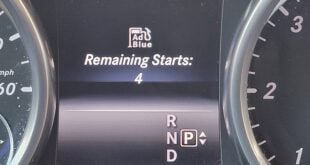
The DEF heater is another known weakness. Most BlueTEC vehicles use diesel exhaust fluid, also known as AdBlue, but not all of them. The 2007 to 2009 E320 BlueTEC used a DeNOx storage catalyst and has no AdBlue tank or heater at all, so none of this applies to that car. The ML320, GL320 and R320 BlueTEC from 2009 onward, and the Sprinter, do carry a urea tank. It is stored in an external tank and would freeze in cold weather. To prevent this, the DEF tank has an electric heater, which can burn out. If this happens, you will be warned with a ‘check engine’ light. While the outside temperatures are not very low, this will not affect the engine performance.
Yet, don’t forget that DEF will freeze in a cold climate. Quotes for this job vary enormously, and the reason is worth knowing before you accept one. On many of these cars the heater is not sold as a loose part, so what gets quoted as a heater is really a complete AdBlue tank assembly, which is where four figure estimates come from. Ask the shop that question directly: is this quote for a heater element or for a tank? The answer usually explains the whole difference, and it tells you whether a used or remanufactured tank is worth considering.
Limp Mode
If your Mercedes loses power, it may be in ‘limp home’ mode. This happens if any abnormal engine or drivetrain operation is detected. The engine computer cuts fuel delivery and, on these variable geometry turbochargers, drives the vanes to a default failsafe position. It cannot switch the turbo off, since an exhaust driven turbo spins whenever the engine runs, so the loss of boost you feel is the vane position and the fuel limit rather than a dead turbocharger. That matters, because the turbo gets blamed and replaced for this constantly. In extreme cases, it will even limit the gear selection to one gear and reverse. This is done to prevent any damage to your engine and force you to fix the problem without delay.
Faulty EGR valves, swirl flap motors, turbocharger actuators, or boost leaks are the usual causes. Make sure you have traced down the actual cause of the problem before changing anything. Remember that a turbocharger that is not working doesn’t necessarily mean it is broken.
Oil Leaks
Oil leaking from the oil coolers is a problem that affects the OM642 V6 diesel from 2007 onward. This is a common oil leak source on all Mercedes engines. Hardened oil cooler gaskets cause it. The good news is that the oil cooler itself can be reused. In addition, upgraded seals are available.
This means that once replaced, seals will not leak anymore. The bad news is that the oil cooler is located between the engine heads, in the depth of the engine Vee. This means the intake manifold, turbocharger, and much more must be removed. This makes it expensive to repair if you take it to the garage. However, you can save a lot of money if you do it yourself.
Glow Plugs
Glow plugs are an essential component for the cold start of every diesel engine. These are, in essence, strong electrical heaters. As the car ages, the glow plugs can fail. The symptoms are a long cranking time and rough running in the first several minutes.
Although changing them is a relatively simple job, remember that a stuck glow plug can break during removal. You will need a plug removal tool for this. The glow plug module can also go bad.
Conclusion
Whatever symptoms you have, avoid guessing. Read the codes and the live data before replacing anything, because on this list the two parts most often replaced, the DPF pressure sensor and the filter itself, are also the two most often replaced unnecessarily.
These problems affect various models. Mercedes-Benz makes some of the best diesel engines. If you want proof, check out all the Sprinter vans with over 500,000 miles on the OM642 engine.
On these cars the useful readings are not the fault codes alone. A tool that talks to the Mercedes engine control unit will show you the calculated soot load in the filter, the differential pressure the DPF sensor is reporting, the time and distance since the last completed regeneration, and whether a regeneration was attempted and aborted. Those four numbers together tell you whether you have a failed part or a drive cycle problem, which no code on its own can do. The same tool can start a forced regeneration while the car is parked, which is the correct first move on a loaded filter.
The YOUCANIC UCAN-II Pro reads these Mercedes specific engine and emissions values and can run the service routines, which a generic code reader cannot. It covers nearly everything Xentry does apart from online VIN coding, so it is a realistic way to make that call from your own driveway instead of paying for diagnostic time first.
Some of these faults come back to a control unit rather than a sensor: a glow plug module that has failed internally, or an engine control unit damaged by water ingress, a jump start, or a deeply flat battery. A dealer replacement has to be coded to the car, which is what makes the quote so large. Module Medics repair Mercedes engine control units, glow plug modules, SAM units and related modules at board level and return your own unit, so the car keeps its existing coding and nothing has to be matched again. Get the codes read first, because this only applies when diagnosis actually points at the module.
Related reading
Before you buy parts, scan every control module, not just the engine. It shows the root fault behind the warning lights and tells you whether the problem is still active. See how to do a full health check.