 MB Medic Mercedes-Benz Repair Guides, Service, How To DIY

How to replace the alternator on a Mercedes-Benz.
If your instrument cluster displays a warning such as ‘Battery/Alternator Defective. Visit the workshop,’ do not assume that the alternator needs to be replaced immediately. First, test the battery and charging system to confirm the cause of the warning. In this article, we will show you how to replace the alternator on a Mercedes-Benz. Replacing the alternator at the dealer can cost you over $1000, but if you do it yourself, you can do it for as little as $90, so keep reading. Alternator replacement cost varies significantly depending on the vehicle, alternator output, brand, labor rates, and whether the unit is new, remanufactured, or OEM. It’s not a complicated job, and we know you can do it. This guide demonstrates alternator replacement on a Mercedes-Benz W203 C-Class equipped with an M112 engine. The general procedure is similar on other M112/M113 applications, but access, component removal, alternator type, and electrical connections may vary by model and engine.
Before buying an alternator, I’d recommend:
- Inspect the serpentine belt and tensioner.
- Check battery condition.
- Check battery terminals and grounds.
- Measure battery voltage with engine off.
- Measure charging voltage with engine running.
- Scan for relevant fault codes.
- Check alternator output/current if appropriate.
- Confirm the alternator is actually defective.
For this job, you will need a female E-Torx tool set , which you will need to remove the two bolts that hold the alternator in place. Note the position of the spacer sleeve/bushing at the alternator mounting bolt and make sure it is correctly positioned before tightening the bolts. Below is a picture of these sockets, and if you need a set, you can find them on Amazon for under $20.


Step-by-step instructions on how to replace the alternator on a Mercedes-Benz
-
- Open the hood.
- Switch the ignition off and disconnect the negative (-) battery cable before working on the alternator. Make sure the disconnected cable cannot accidentally contact the battery terminal. HINTS: Locating the battery. If you have a C / E / CLK class, it could be. Battery location varies by model and chassis. On the W203 shown in this guide, the battery is located in the engine compartment. We are working on a C-Class W203 2001-2007; the battery is in the engine bay. First, we need to remove the cabin air filter housing. Push up the 3 clips in the picture below and pull out the housing.

- Remove the bolt on the NEGATIVE battery terminal clamp and disconnect the cable. You will need to loosen the 10 mm bolt; no need to remove the bolt altogether.
- Remove the engine cover. It comes right up. It has clips that hold it in place and no screws.

- Remove the serpentine belt. Read this article and watch the video on replacing the serpentine belt.

- Remove the protective cap from the alternator B+ (Terminal 30) connection. Remove the retaining nut and disconnect the B+ cable. Then disconnect the smaller Terminal 61/D+ electrical connector.
- You should see a nut. Remove the 13mm nut on the back of the alternator. See the close-up picture below.
- Unplug the connector that goes into the back of the alternator. Press on the tab and pull it away from the alternator.
- Remove the two bolts that hold the alternator in place using the female E-Torx sockets
 we listed in the required tools section above.
 - Remove the alternator. Removing it won’t be easy, but you can do it. You may have to use some force in this process. This step won’t be fun. The alternator may be tight in its mounting bracket. If necessary, carefully work it free without damaging the mounting bracket, electrical connections, or surrounding components.
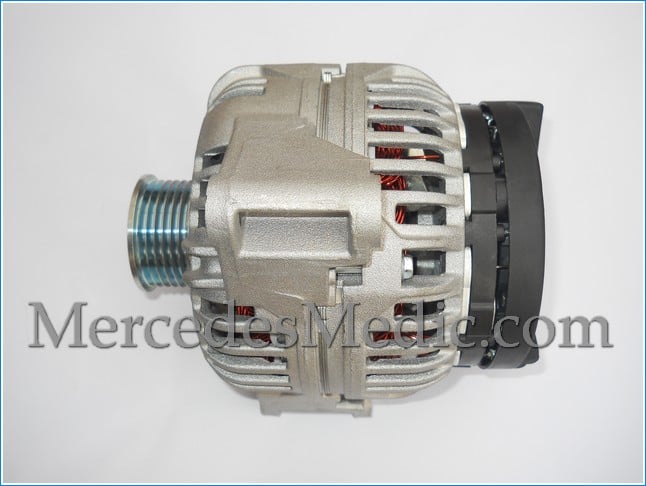
- Install the new alternator. Here are some pictures of our new alternator, which we bought for $115 on Amazon. If you need a replacement alternator at a fraction of dealer prices and even cheaper than your local parts store. Note the position of the spacer sleeve/bushing at the alternator mounting bolt and make sure it is correctly positioned before tightening the bolts.

- Install the new alternator and tighten the two bolts to 42 Nm.
- Connect the electrical cable to the alternator. Tighten the nut for the electrical cable ( positive +) between 15-18Nm.
- Plug the electrical cable on the back of the alternator and make sure it clicks when you push it in. That way, you know it is locked in place.
- Route the serpentine belt according to the vehicle’s belt-routing diagram and verify that the belt is fully seated in every pulley groove before starting the engine and the engine cover, and reconnect the battery.


Torque Specifications
- 2 Bolts that hold the alternator in place. Max 45 Nm.
- 1 Bolt on the back of the alternator. Between 15 Nm and 18 Nm.
How much does a Mercedes-Benz alternator replacement cost?
The answer depends on where you live. With that in mind, we will give you a general idea. First is the price of the alternator. If you buy it at the dealer, you can spend around $1000 to replace the alternator. If you do it yourself, you can save hundreds and replace the alternator for 1/10 of that. How?

Applicable Models
C Class Models: C240 C320 C32 C280
CLK Class: CLK320 CLK430 CLK55
CROSSFIRE
Related Part Numbers
Bosch Alternator 12 120 Pulley Rotation Polarity
Bosch 0124515046, 0986042550, 0124515132
Delco DRB2550
Chrysler 5097755AA, 5097756AA
Mercedes 0111546802, 011-154-72-02
Mercedes A011-154-68-02, A011-154-72-02
Valeo 2542317, 437222, 542317, SG12B021
Bosch 0-124-515-056, 0-124-515-132, 0-986-047-540
Alternator part numbers vary by model, engine, production date, electrical equipment, and alternator manufacturer (Bosch or Valeo). Always verify the replacement alternator by VIN or by matching the part number and amperage of the original unit.
Related Article:
What Scanner Can I Use to Troubleshoot Mercedes-Benz Alternator Problems?
If you’re experiencing problems with your Mercedes-Benz, a YOUCANIC full system diagnostic scanner can help you troubleshoot the issues. This advanced diagnostic tool can read and interpret the fault codes stored in your car’s computer system, providing detailed information about any problems with the engine, transmission, brakes, or other critical systems.

Please use the comments section below to let us know how your job went. Feel free to post any recommendations or suggestions to help others.


