 MB Medic Mercedes-Benz Repair Guides, Service, How To DIY

Last updated:
In this guide (5 sections)
Defective valve body and conductor plate issues have affected many Mercedes-Benz cars with 722.9 7G Tronic Automatic Transmissions. If these parts fail, they will require replacements to extend the life of the transmission. For the wider picture on this gearbox, see our guide to its common problems and solutions. The early 722.9 transmissions installed on Mercedes-Benz models between 2004 and 2008 had a higher failure rate. Most of these transmissions were identified as VGS1 and required the replacement of both the valve body and the conductor plate.
Mercedes-Benz Refusal to Sell Replacement Valve Body and Conductor Plate
 Unfortunately, Mercedes-Benz declined to sell replacement valve bodies to independent repair shops, claiming that these components were related to the vehicle’s security. Yet they will sell complete transmissions. Mercedes-Benz claims it will not sell the valve body because it could aid in automobile theft. In reality, all that was happening was that dealers had the unfair advantage of being the only ones who could repair these cars, while independent repair shops were limited in being able to fix these cars.
With the problem becoming more common, we understand that Mercedes-Benz will now sell those parts to independent shops. A TRP paperwork needs to be completed with the owner’s information and details on the vehicle, such as VIN and vehicle log reports.
Failed Valve Body and Conductor Plate
Typically, when the valve body or conductor plate fails, you may experience the following symptoms:
- The transmission is stuck in second gear. Limp Home Mode
- It shifts from first to second gear and stays in that gear.
- The transmission will not shift into higher gears.
- Can not drive at speeds over 40 mph.
- Check engine light is ON.
- Erratic shifting of gears.
- Jolting while changing gears.
- Engine RPMs are high, but the car doesn’t move.
While these are the typical symptoms of a failed valve body or conductor plate, Mercedes-Benz transmission can go into LIMP MODE due to other issues that may not be directly related to the transmission.
These transmission problems may start developing as early as 50,000 miles. Replacing the valve body will cost between $2,000 and $3,000.
Reprogramming the Transmission Control Unit (TCU) with the latest software is unlikely to permanently fix valve body or conductor plate issues. It could make gear changes smoother for those not experiencing transmission problems, but it should not be seen as a solution when the failure is due to hardware.
Root Cause
The problem is usually the speed sensors located in the conductor plate. The conductor plate bolts are on top of the valve body inside the transmission. If you scan your Mercedes-Benz with a diagnostic scanner, you may get several error codes pointing to speed sensor faults. You can not replace the speed sensors themselves; therefore, you must replace the conductor plate. Luckily, the transmission does not need to be removed for you to replace the conductor plate.
The early 722.9 transmissions (MY 2004-2007) identified as VGS1 on top of the TCU required that you replace both the valve body and the conductor plate. 
In newer units, second-generation (VGS2) and third-generation (VGS3) can be repaired by replacing the conductor plate and TCU unit only. The new TCU unit must be virgin and married to the vehicle using SCN coding.
How to remove/replace the valve body on 722.9 7G?
Replacing the valve body on the 722.9 7G Tronic. Replacing the valve body on a 722.9xx requires the TCU to be “virgin” and “married” to your car. That means the TCU can not be from a used car. In the 722.9 transmissions, the TCU is on top of the conductor plate. It may have Siemens VDO printed on top. This requires that you purchase the replacement parts from the dealer.
It is also possible to virgin a TCU. Some facilities can take a used TCU and make it virgin again by erasing the information of the previous vehicle.
Instructions on replacing the valve body on the 722.9 7-speed transmissions are generally the same as those on the 5-speed automatic transmission.
The following video shows step-by-step instructions on how to perform this procedure.
Make sure to reinstall the B3/2 valve. If you don’t, your Mercedes-Benz may not move when you switch between the Economy / Sport / Standard mode using the switch on the shifter module.
Location of Solenoids and Clutches
 The picture below shows the location of the solenoids and clutches on the 722.9 Mercedes-Benz transmission, which include:
- Lock Up Solenoid
- Working Pressure Solenoid
- K2 Clutch
- K1 Clutch
- B2 Brake
- B1 Brake
- B3 Brake
How to replace the solenoids
Replacing the solenoids from the Mercedes-Benz 7-speed transmission is very easy once you remove the valve body from the transmission. You will need to Torx T-40 bit to remove the bolt holding the clamp. Once the clamp (bracket) is removed, you can pull the solenoids straight up to remove them. Reinstall the solenoids in reverse order. Tighten the T-40 bolts to approximately 70 in-lb.
Remove the conductor plate
Use the T-30 Torx bit to remove the conductor plate bolts. 7 bolts need to be removed to remove the conductor plate from the.
VGS Conductor Plate
There are three conductor plates for the Mercedes-Benz 7-Speed 722.9 automatic transmissions. The conductor plates are designated as models:
- VGS 1 – Requires Replacement of Valve Body and Conductor Plate
- VGS 2
- VGS 3
How do I know which VGS conductor plate I have?
Look for a number printed on top of the VGS / VDO. You should have a number such as VGS 3.

Reading the transmission yourself
A failing conductor plate reports itself through the transmission control unit rather than the engine, which is why a basic code reader can come back clean while the car is shifting badly or sitting in limp mode. The codes that matter are the ones for the transmission’s internal speed sensors, and our article on P0720 and P0715 on a Mercedes transmission covers what they mean and what else can set them.
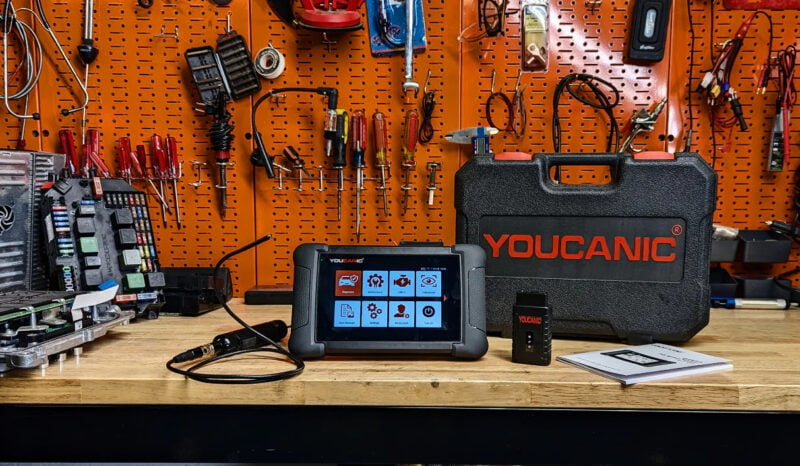
Seeing them takes a scanner that talks to the transmission module rather than one limited to emissions readiness, and the YOUCANIC UCAN-II Pro is one example of that class of tool. Worth being plain about where the line falls: reading and clearing those codes and watching live data is one job, while coding a replacement conductor plate to the car is another and still needs dealer level software. The value of a scan here is knowing whether the plate is actually your problem before you spend anything on parts. If the car is already in limp mode, our checks for limp mode and no shifting are the place to start.
Before you buy parts, scan every control module, not just the engine. It shows the root fault behind the warning lights and tells you whether the problem is still active. See how to do a full health check.

My CLS500 2006 is showing ABS and ESP error while the steering is also stiff. This started recently when i changed the VGS (conductor plate). the workshop is finding it difficult to rectify this fault
I’m told by a MB shop that the front carpet need to come up for valve body replacement. Is this so.
Just purchased my 2006 CLS 500.w/ 72k miles. I havent had the car for 3 mos and I have already replaced the suspension. Lost speed while driving. Took into dealer just to find out I need a new valve. My extended warranty will not cover the Transmission Valve because its listed as a Technical Service.
Want to order 722.9 7 plate
my 2005 e500 wagon was doing all this stuff in “sport” – I then put the transmission on “comfort” – all is well – how long before “comfort” gives out (I’ve 118,000 on car)?Dealer wants $1800 to repair…
I have similar problem and fault showing is “the internal electrical check of component Y3/8Y5 (B 1 Brake control solenoid valve (VGS) has failed.
This is exactly what I am experiencing on my 2006 R320. Would this be the cause? It is booked in at a Mercedes repair shop to have a diagnostic check, fortunately I took out an extended warranty when I purchased the car 6 months ago. Any other advice?
What were the codes and the diagnostic results?