 MB Medic Mercedes-Benz Repair Guides, Service, How To DIY

Last updated:
In this guide (6 sections)
Are the BAS, ASR, and ABS lights staying ON in your Mercedes-Benz? This article will show you how to troubleshoot BAS/ASR light problems. What ASR, BAS, and ABS lights mean. Common problems and possible solutions.
Common Mercedes-Benz BAS and ASR problems
- ABS/ ASR/ BAS Fault Codes
- BAS/ASR Light Stay On Instrument Cluster
- Mercedes goes into limp mode, stuck in gear
What do the ABS, BAS, and ASR lights mean?
If any of these lights turn on and stay ON once you start to drive the car, it means there is a problem with one of the following systems or related sensors.- ASR Light Meaning: Anti-Slip Regulation / Acceleration Skid Control
- BAS Light Meaning: Brake Assist System
- ABS Light Meaning: Antilock Brake System
Troubleshooting the BAS, ASR, and ABS lights

Step 1: Ensure that the main battery on your Mercedes-Benz is holding a proper charge. Mercedes-Benz cars are very sensitive to low voltage. An old battery can cause BAS and ASR lights to stay on. It is common for the BAS and ASR lights to come on with a dead battery. It takes a while for a discharged battery to charge fully. Your Mercedes-Benz battery should have its manufacturing date stamped on top or the side. If your battery is over ten years old, consider replacing it even if the car has been starting fine. Don’t wait until your Mercedes battery is completely dead.
If you need a reasonably priced Mercedes battery, read this article: Top 5 Batteries for Mercedes-Benz.
Step 2: Check the brake light switch. The brake light switch is probably one of the main causes that trigger BAS and ASR light problems. The switch doesn’t only turn on the brake lights on the rear, but other systems, including ABS, ASR, and BAS, also use the input from the switch.
To check if the brake light switch is the problem, pay close attention when the BAS and ASR lights come on.
Do ASR and BAS lights come on when you press the brake pedal?
If the ASR and BAS lights come on when you push the brake pedal, the brake light switch is most likely the problem.
It is not worth repairing the original brake light switch. Since the brake light switch is relatively cheap (check prices on Amazon) and often the main problem is that it is better to replace it. Replacing the brake light switch is easy. Watch the following video on changing the brake light switch on a Mercedes-Benz.
Step 3:
If you replaced the brake light switch and are still having problems with the BAS/ASR lights, the next thing to check would be the ABS wheel speed sensors. They are installed on two (diagonal) or all four wheel knuckles and measure wheel revolutions.
How do you know that the ABS sensors are defective?
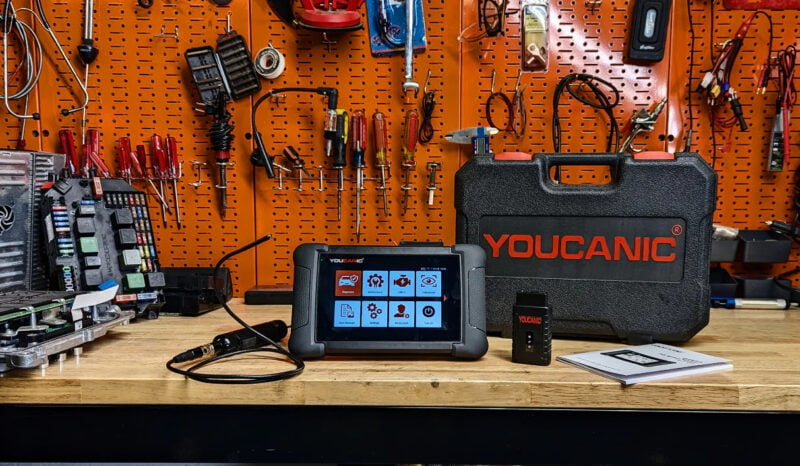
The best way to diagnose an ABS sensor is to use a diagnostic scanner such as the YOUCANIC full system scanner. Note that you need a full system scanner, and a basic OBD-II scanner can only diagnose the check engine light and will not read/erase codes related to ABS, BAS, and ASR. A full system scan is what tells you which sensor is at fault, rather than leaving you to replace all four and hope.
Let’s say you don’t have such a scanner or can’t invest in one yet.
Here is a tip: Pay close attention when your BAS and ASR lights come on.
Why do the BAS/ASR lights come on when you start driving but not when you press the brake pedal?
Typically, this happens when one of the ABS sensors is defective. The BAS/ASR light usually comes on when you exceed five mph.
Step 4:
 Check the rear brake lights. Do they work properly? Does the third brake light work? It is not uncommon for a short to develop in the brake light circuit and cause exactly this. Unplug the rear brake lights and check for corrosion if the rear brake lights don’t work. Check the connections that plug into the brake light assembly. You may want to use a digital multimeter to check continuity or to ensure there is no short. In a few cases, we have seen wires inside the headlight & tail light fried and causing shorts and malfunctions.
Conclusion
We hope one of these article’s tips will fix your BAS and ASR light problems. Check the brake light switch, car battery, and ABS wheel sensors. If you still have BAS/ASR light problems, it may be time to have an auto mechanic or a Mercedes-Benz dealer perform a diagnostic. Or, if you are a DIYer, use the YOUCANIC full system scanner to run a diagnostic yourself.
If you want to figure out the BAS/ASR problem on your own, you will need to get hold of an advanced diagnostic scanner to do a complete system scan and read the fault codes. The error codes will give you a good idea of the cause of the BAS and ASR lights staying on. Other possible problems triggering the BAS/ASR light are a defective SAM module, a bad ECU, or ABS module.
Clear the codes after you fix the cause, or the lights stay on
This is the step the troubleshooting above does not mention, and it sends a lot of people out to buy parts they did not need.
The ABS and ESP control units store faults. A code logged during a flat battery or a bad brake light switch does not clear itself just because the cause is gone. Fit a new battery, fix the switch, and the lights can stay exactly where they were, which reads as a failed repair when it was actually a successful one waiting to be acknowledged.
So the order matters:
- Fix the cause you identified above.
- Clear the stored ABS, BAS and ASR codes.
- Drive the car, then re-scan.
What comes back on that re-scan is the real answer. A code that returns immediately is a live fault and you have more work to do. A code that does not return was history, and you are finished. Without that clear and re-scan cycle you cannot tell those two situations apart, and guessing is how a brake light switch job turns into four wheel speed sensors.
As the article notes above, a basic OBD-II reader will not do this. It cannot see ABS, BAS or ASR codes at all, let alone clear them. The YOUCANIC UCAN-II Pro reaches those control units, and it also shows each wheel speed sensor as a live value, so you can roll the car slowly and watch whether one corner reads zero or jumps around while the other three climb together. That is the reading that names the failing sensor instead of replacing all four.
When it really is the module
The conclusion above names a faulty SAM, ECU or ABS control unit as the remaining possibilities, and those are the expensive end of this fault. Worth knowing before a quote lands: a replacement control unit has to be coded to the car, while a board level repair of the original does not, so the coding and the adaptations stay as they are. Module Medics repair these units at board level and return the original.
One honest caveat before sending anything away: confirm the module is actually the fault first. A module that merely reports a sensor or voltage problem is doing its job correctly, and swapping it changes nothing. The clear and re-scan cycle above is how you tell the difference.
Related reading
Before you buy parts, scan every control module, not just the engine. It shows the root fault behind the warning lights and tells you whether the problem is still active. See how to do a full health check.


Would anybody trust Firestone to fix wheel sensors. Lastly, will the warning lights go off after they finish.
Sure why not. If the ABS light was turned on due to a bad wheel speed sensor, the light usually goes off after the fix. There will be stored codes though. Ask the mechanic to read codes before the repair and clear them afterward.
Would you trust a firestone to replace wheel sensors and the magnet on each wheel. Lastly, will the warning lights on the dash go off.
New bat in, did the wheel turn thing several times, light still comes on about 30 sec after starting down the road.??
Most likely a wheel speed sensor or the ABS pump itself are defective.
This is great help. My 2000 e320 wagon was rear ended, and this makes sense. I will fix it now.
Thanks a lot!