 MB Medic Mercedes-Benz Repair Guides, Service, How To DIY

Last updated:
In this guide (9 sections)
Your Mercedes-Benz starts fine in the afternoon but refuses to start on a cold morning, and by the time the day warms up the problem has vanished. An intermittent ignition fault that tracks the temperature like this is usually caused by cracked solder joints inside the Electronic Ignition Switch (EIS/EZS), though a weak battery, a failing key or a faulty SAM module can produce similar symptoms. This guide covers the symptoms, why temperature makes the difference, and how to work out which component is actually at fault before you replace anything.
The symptom pattern
- The Mercedes-Benz key works intermittently. It works properly when it is warm. When it is cold or the temperature drops below 20 degrees Celsius, it stops working.
- The key doesn’t start the car when it is cold.
- The key and ignition work properly all day when it is warm.
What causes it
- These symptoms are often caused by weak joints in the EIS (Electronic Ignition System). Sometimes, these problems can be due to a defective SAM (Signal acquisition module).
Finding out which module it is
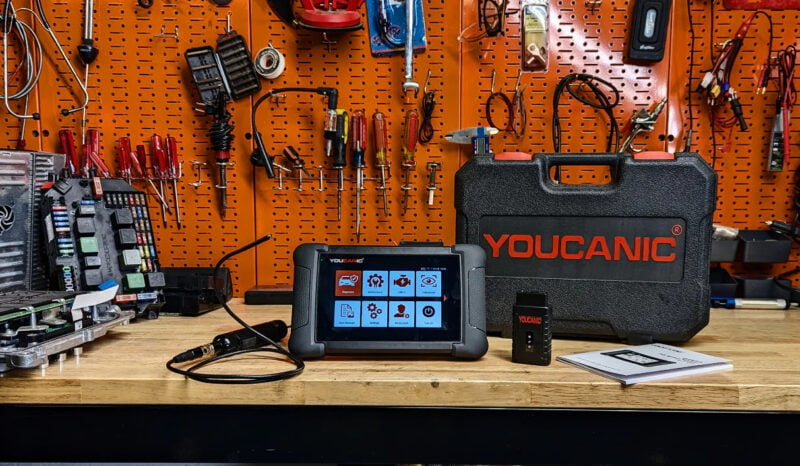
The first job is to establish whether the fault is the EIS, the SAM module, the key or simply the battery, because all four produce a car that will not start on a cold morning. That means a tool that can talk to the EIS and the body modules rather than only the engine, since a basic code reader cannot reach them at all. The narrowing steps further down cost nothing and should come first; the scan is what confirms the answer.
Once you identify the defective module, you can get it repaired. You can find services to repair your old EIS and SAM module online. Module Medics repairs and clones Mercedes EIS modules as a mail in service, so your original keys keep working and no dealer programming is needed.
 Note that your original EIS module can be repaired and reinstalled without reprogramming. A used EIS module will not work as a straight swap, even if the part number is identical. EIS modules are locked to the vehicle, so the data held in the module has to match the car. A donor module can still be used, but only after your original data is transferred onto it or the previous vehicle’s data is erased, a process often called virginizing. That work is what cloning services do, and it is why your existing keys continue to work afterwards. Your other option would be to get a new EIS or SAM module from the dealer and have them perform the programming.
Which Mercedes-Benz models are affected
This pattern shows up most often on models using the FBS3 drive authorization system, fitted to Mercedes-Benz vehicles from roughly 1998 to 2014. Commonly reported chassis include the W203, W204, W209, W211, W219, W220, W221, W164, W251, R171 and the Sprinter. The exact system varies by model and year, so confirm what your vehicle uses before ordering parts.
Why the problem follows the temperature
Inside the EIS, the processors and connectors are soldered to a circuit board. Years of heating and cooling, plus vibration, can leave hairline cracks in those solder joints. When the metal contracts in the cold, a cracked joint opens slightly and the circuit stops making contact. As the car and cabin warm up, the metal expands, the joint closes, and everything works again.
That is why the car will not start at six in the morning but starts without complaint the same afternoon, and why the fault often disappears entirely in summer and returns with the first cold snap. A fault that tracks temperature this closely is a strong hint at a physical connection problem rather than a dead module.
The mechanism above tells you the workaround, and it is worth knowing before you are late for work. The EIS sits behind the dash, inside the cabin, so it warms up with the cabin rather than with the engine.
So if the car will not respond on a cold morning, the thing that helps is heat and time, not more attempts. If you can get it running at all, let the cabin warm properly before switching off again. If you cannot, waiting for the day to warm up genuinely works on a thermal joint fault, which is the same evidence that tells you what the fault is.
What does not help is cycling the key over and over. Each attempt is another chance for the cluster to log a drive authorization fault, and stored faults of that kind can make the car refuse even once the joint closes again.
This is a workaround, not a repair. A cracked solder joint gets worse, and the window where heat fixes it shrinks month by month until one morning it does not come back at all.
How to narrow it down before replacing anything
Several different faults produce similar cold weather symptoms, so work through these before condemning the EIS:
- Test the battery and charging system first. A weak battery loses cranking performance in the cold and can mimic this exactly. Check resting voltage and have the battery load tested. On many Mercedes models an auxiliary battery is also fitted and can cause its own starting faults.
- Try the spare key. If one key works in the cold and the other does not, the problem is likely the key. If both behave the same way, the key is less likely to be at fault.
- Watch the instrument cluster as you insert the key. No cluster lights at all points toward the EIS power supply or the module itself. Lights that come on normally but no crank points elsewhere in the system.
- Park it somewhere warm overnight. If the car starts normally after a night in a heated garage and fails after a night outside, that is good supporting evidence of a thermal joint problem.
- Scan all modules, not just the engine. An EIS fault often shows up as communication or drive authorization faults logged in other control units, not as a single obvious code.
A full system scanner is needed for this, because a basic code reader will not communicate with the EIS or the SAM modules at all and will simply report no faults on a car that plainly has one. The YOUCANIC UCAN-II Pro reads these Mercedes body and drive authorization control units and covers nearly everything Xentry does apart from online VIN coding, which on this fault is the difference between knowing it is the EIS and guessing.
One thing to avoid
Do not jump start the vehicle with the key left in the ignition. Voltage spikes during a jump start are a known cause of EIS damage, and a car that was only hard to start in the cold can end up with a module that no longer works at all.
Related fault codes
- B1000, Control Unit N73 EIS / EZS Control Unit is defective.
- B1003, Key recognition failure.
- P1925, Drive authorization refused by the electronic selector lever module.
Codes are a starting point, not a verdict. Low voltage alone can set drive authorization faults across several modules.
Related reading
Before you buy parts, scan every control module, not just the engine. It shows the root fault behind the warning lights and tells you whether the problem is still active. See how to do a full health check.


I have an issue with my keyless ignition. Most of the time it works fine. But sometimes it says not detecting the key. I’ve had the battery changed in the key so I know it’s not that.