 MB Medic Mercedes-Benz Repair Guides, Service, How To DIY

Last updated:
In this guide (7 sections)
 The Low Range function can engage the transfer case in its lower gear range, providing more power and higher torque at the wheels. The maximum speed is limited to approximately 50 mph when Low Range is engaged. Low range is not meant for everyday use. While the top speed is limited, the torque to the wheels is increased. The All-Wheel-Drive (4WD) system is always engaged on your Mercedes-Benz ML.
Low range increases the torque at the wheels by switching the transfer case to a lower (numerically higher) gear ratio, which lets the vehicle tow heavy loads or climb steep off-road terrain at a crawl.
When should you use the Low Range Function?
Use the LOW RANGE mode under the following conditions.
- Off-road driving
- Going up steep inclines
- Towing heavy loads
- Driving in mud
- Driving in water, such as crossing a river. Up to 20 inches / 0.5 meters of water maximum.
NOTE:
Do NOT engage it for driving on snow covered roads. The 4-ETS traction control handles slippery pavement on its own, and the extra torque of low range makes the car harder to control on snow.
DO NOT USE CRUISE CONTROL WHEN IN LOW-RANGE MODE
You should engage the low range several times a year to avoid problems.
How to put a Mercedes-Benz SUV (example ML320) in LOW RANGE mode
To set your ML in LOW Range mode, you need to:
- Stop the car
- Make sure the engine RPMs are under 1500
- Press the brake pedal and move the gear selector to the Neutral position.
- Press the LOW RANGE switch on the dashboard for a couple of seconds.
You should see the LOW RANGE light flash on the instrument cluster three times.
When your Mercedes-Benz is in LOW RANGE mode, the Low Range light will stay constantly on.
To get the car out of LOW RANGE, follow the above procedures. When you press the low range, the LOW RANGE light flashes three times, then turns off to indicate that you have completed the procedure.
Low Range Light Flashing
 If the LOW RANGE lamp flashes on its own after you start the engine, three times or for about three seconds, and then goes out, the transfer case control unit has stored a fault. The lamp blinks without the driver pressing the button, and it will also flash, and never stay on, when you press the low range switch. This can be due to several reasons:
- Transfer case shift motor stuck or out of sync (corrosion, and a motor that is rarely used)
- Transfer Case Control Unit Defective
Mercedes-Benz even issued a service campaign for the transfer case control unit problems. Download the PDF file below to read the details of the campaign.
 ML Control Module Campaign 1998060001 (Source: workshop-manuals.com)
What does it mean if the Low Range Light Blinks
If the Low Range light flashes three times and then goes off when you start the car, you can still drive your Mercedes-Benz SUV (such as an ML320 or ML350) normally in high range. Do not read the flashing as a sign that low range is ready: it is the control unit telling you it has a stored fault, and low range may not engage when you need it on a steep incline, so plan to read the code.
Troubleshooting Tips
If the Low Range light is blinking or flashing and doesn’t stay on, it means there is a problem. The next step in diagnosing the problem is to retrieve the fault codes from the transfer case control unit and the ABS, ETS and ESP module. Before you buy any parts, also check the fuses; our 1998 to 2005 ML fuse box chart shows where they are.

You will need a diagnostic scanner that reads those modules; a basic engine code reader will not show them. Using the scanner is simple; follow the steps in the following video. In this video, you will see how to use the scanner to retrieve the fault codes from the Airbag module, but you will need to read the fault codes from the Traction Control module.
Possible Solutions
The most common problem is the transfer case motor losing synchronization or getting stuck due to corrosion, and the fact that it rarely gets used.
The first thing that you should try is to repeatedly engage the low range mode. Try several times, at least 15 times to see if the low range will engage. If the motor does not engage (synchronize) that means that the transfer case motor most likely is defective.
The transfer case motor can be easily replaced on your ML. Below is a picture of the transfer case motor.
 Transfer Case Motor on an ML320 part number 163 540 09 88
If your ML is stuck on the low range, you could replace the transfer case motor, or you may be able to fix the problem by replacing the transfer case motor gear.
Here is a helpful video: DIY Low-Range Transfer Case Motor Removal and Replacement, if you decide to replace the Low-Range Transfer Case Motor yourself.
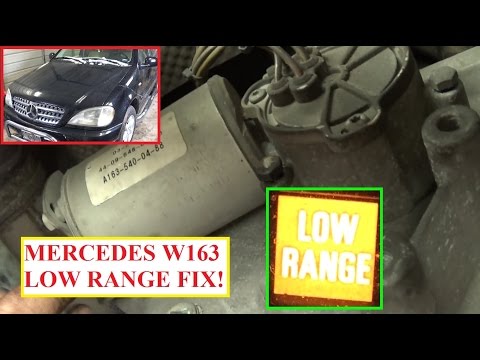
If you can not get hold of a replacement transfer case motor, you may want to try the trick mentioned by a Mercedes-Benz owner on MBWorld.
Read the Code Before You Buy a Motor
The two causes above, a stuck shift motor and a failed control unit, light the same flashing lamp, and the motor is the expensive guess. The fault stored in the transfer case control unit tells them apart before you order anything, and after a motor swap you can clear it and confirm it stays away. A basic OBD2 code reader stops at the engine and never sees that module. A scanner that reads every control unit in the car, such as the UCAN-II Pro, reads and clears the transfer case and ETS codes on the ML, which is the step this article has been pointing at since the light started flashing.
Before you buy parts, scan every control module, not just the engine. It shows the root fault behind the warning lights and tells you whether the problem is still active. See how to do a full health check.

